
Radio as Instrument ←
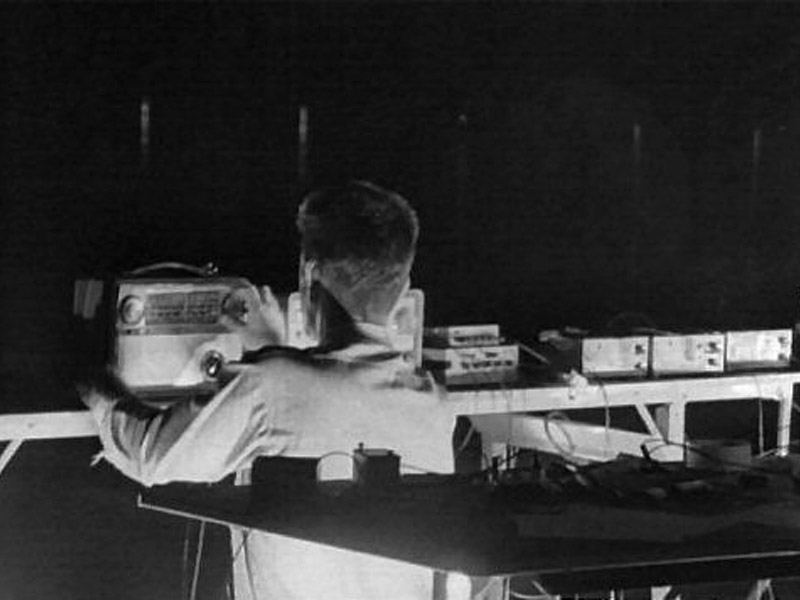
John Cage ←
“At one point, Cage rose up from below the stage on a hydraulic platform playing the piano. People were furious. I was flabbergasted. He used a radio as one of his instruments, too. At one moment he turned it on and got the voice of the Pope asking for peace in the world. It was a wonderful moment. One man strode down the aisle with a cane. He hit the piano and said, “Now I am a composer!” I guess you could say that concert blew my mind. I stopped writing music for a year.” Alvin Lucier, Music 109
From John Cage and Richard Kostelanetz: A Conversation about Radio
How did you develop in the early fifties the notion of using radio as a musical instrument?
There was a tendency through the whole twentieth century, from the Futurists on, to use noises, anything that produced sound, as a musical instrument. It wasn’t really a leap on my part; it was, rather, simply opening my ears to what was in the air.
Do you remember your thinking at that time?
Yes, my thinking was that I didn’t like the radio and that I would be able to like it if I used it in my work. That’s the same kind of thinking that we ascribe to the cave dwellers in their drawings of the frightening animals on the walls—that through making the pictures of them that they would come to terms with them.
Now why did you choose twelve radios, rather than just one, for Imaginary Landscape No. 4?
There’re so many possible answers; I don’t remember which one was in my head. One is the twelve tones of the octave, and the other is the twelve disciples, and so on. It seemed like a reasonable number.
Didn’t you have two operators for each radio?
Right. One controlled kilocycles and the other controlled the tone control and the volume.
Were those twenty-four radio-performers musicians?
Yes, they were. They could all read notes, and there was a conductor who was beating 4/4 time.
Who was he?
I was doing it.
My recollection is that there was something special about what time of day this performance was.
The first performance had almost no sound in it. Two friends of mine at the time, Henry Cowell and Virgil Thomson, both attributed the absence of sound to the fact that it was late at night—it was nearly midnight. However, I knew that the piece was essentially quiet through the use of chance operations and that there was very little sound in it, even in broad daylight, so to speak. The volume levels would always be very low.
What about your other works for radio at that time.
Radio Music [1956] and Speech [1955] “for five radios and newsreader. They’re slightly different, but the radio piece was written more or less to please the people who were disturbed over the Imaginary Landscape No. 4 because it was so quiet. I forget what I did, but it can be played so as to be loud
Your catalogue of twenty years ago says that in Radio Music “durations of tunings are free,but each is to be expressed by maximum amplitude.
It does? Well then it’s obvious that that’s what it was. If people wanted radios to be loud, that was the piece to play.
How did your writing these pieces change your attitude to radio, at least in your persona life?
JC: It made it possible for me to listen to radio with great interest, no matter what it was doing.
And what did you listen to then?
Anything that I happened to hear. I didn’t myself turn on a radio to listen to it; but when I was going through the streets or when a neighbour was playing the radio, and so forth, I listened as though I were listening to a musical instrument.
Did radio become a favourite musical instrument?
Almost as favoured by me as the sounds of traffic.
- Credo in Us: “The instrumentation for the original performance included… a fourth performer operating a radio and a phonograph… use any station but avoid news programs in the case of a ‘national emergency’.
- Imaginary Landscape No. 4 (March No. 2), for 12 radios, 24 performers and a conductor (April 1951): “Cage raised his baton and began beating time. The performers diligently twisted knobs and dials, sweeping around the airwaves and manipulating volume. What the audience heard was the gentle crackle and hiss of radio static as the players glided between stations. Occasionally there was a burst of speech, a snatch of music, the reassuring flurry of violins playing a sweet, late-night melody. The audience giggled, coughed, and applauded wildly when a recognisable fragment of Mozart blasted out.”
- Speech 1955, for news reader and 5 radios (November 1955)
- Radio Music, for 1 to 8 performers using radios (May 1956)
John Cage & Don Buchla ←
“Well, [David] Tudor was one of my first customers. Cage and Tudor visited me at my studio in Berkeley and I remember that occasion. My studio at that time was ten feet wide and I worked out on the sidewalk. It was so crowded in there we hauled the workbench out on the sidewalk on good days and set up my oscilloscope and worked out there. Cage came by and for voltage control I had hooked up my keyboard to an FM module that I’d built, a little module that was an FM receiver and I could play stations on it because I had one of the first varactor tuned FMs. Cage, as you can imagine was, just enormously interested in the fact that I could tune each key to a station and then proceeded to play the radio. I had already met Cage while putting together some of his pieces that involved perhaps multiple radios, phonographs and so on”
Don Buchla, from an interview transcript at the Vasulka archive
Karlheinz Stockhausen ←
- Kurzwellen (Short Waves), for six players with shortwave receivers and live electronics (1968): “For Cage, the type of radio is a matter of indifference, since their purpose is merely to fill in prescribed time units with any sort of sound at all. Stockhausen, on the other hand, prescribed short-wave receivers because of their capability of bringing in broadcasts from far away, and for the rich variety of available sounds. These sounds are also not used indiscriminately: the performers are to search for and select only materials suitable for improvisational transformations.
- For the Beethoven bicentennial in 1970, Stockhausen created a version of Kurzwellen that supposed a special case in which all radio stations just happened to be broadcasting material by Beethoven. This version is known variously as Kurzwellen mit Beethoven, Kurzwellen mit Beethoven-Musik, Stockhoven-Beethausen, and Opus 1970 (Hopp 1998, 263). In order to produce this situation, Stockhausen replaced the radios with four different tape collages of excerpts from Beethoven compositions interspersed with readings (by Stockhausen) from the Heiligenstadt Testament, subjected to a variety of electronic transformations to simulate the effect of short-wave transmissions. These tapes could be “tuned in and out” by the performers, just like radio transmissions.”
Other inspiration ←
- Alvin Lucier talking about Morton Feldman: “He told me once that he got the idea for this piece while sitting on the beach at Far Rockaway, Long Island. Occasionally the wind would blow sounds his way, fragments of conversations, music from transistor radios. You’ve had that experience haven’t you? It’s just beautiful when a little sound comes to you on the wind.”
- Brian Eno recorded US radio broadcasts to use on My Life in the Bush of Ghosts
- Akufen’s 2002 debut album “My Way”… was entirely built around a series of tiny unrecognizable samples Leclair took from local FM radio. (Source)
- “Hilversum 2 was precisely in the right place. The red calibration indicator stood right in the middle of the 298-meter wavelength panel… He moved along the dial, and most of the stations came in very clearly. Luxemburg and Rijssel played dance music, a man in Munich said, “Achtung, meine Damen und Herren.” A symphony orchestra was performing in Strasbourg, “here national Program” said a lady in Droitwitch… Brussels followed, 1 and 2, and London, Paris, Rome - yes, Rome! Hilversum 1, Vienna, Stuttgart, Beromünster! Hans listened to an opera in Paris, to gramophone music from Rome, lovely violin music from Stuttgart. All Europe was present: He traveled in one turn on the dial from Hilversum to Vienna, from Rome to London; the countries lost their borders. The most alien peoples stood next to him - next to him in his little chamber. He heard voices from strangers hundreds of kilometers away as if they were standing next him, and he immediately understood the meaning of what he had reading in so many radio advertisements: ‘Make the world your neighbor’” (Leonard Roggeveen, “The Radio Detective”, 1930, quoted in Wireless Imagination by Kahn & Whitehead)
Sources:
http://www.theguardian.com/music/2009/aug/06/john-cage-symphony-for-radios
http://en.wikipedia.org/wiki/List_of_compositions_by_John_Cage
http://en.wikipedia.org/wiki/Kurzwellen
http://monoskop.org/log/?p=4822